

Germany's defence capability is receiving more attention than ever. At the same time, few industries are subject to regulatory requirements as strict as those governing medical technology. This combination gives rise to considerable practical challenges. Russia’s war of aggression against Ukraine illustrates this particularly clearly: medical devices intended for military deployment may remain in the field for months, are exposed to extreme temperatures, humidity, dust and mechanical stress, and are often used by soldiers – rather than medical professionals – for self-aid and buddy aid.
For such products, the regular route to CE marking under the Medical Device Regulation (“MDR”) quickly reaches its limits. In particular, the clinical data normally required for conventional medical devices can only be collected to a limited extent, if at all, under actual deployment conditions. A battlefield cannot be recreated in a clinical investigation. In addition, other obstacles include lengthy procedures at the notified bodies (conformity assessment bodies within the meaning of Article 2(42) MDR), small quantities and a product predominantly intended for military use, which makes a full conformity assessment procedure economically unattractive.
What is less well known is that medical device law already provides a special framework for such cases: the Federal Ministry of Defence ("BMVg") can grant special authorisations for medical devices intended for special tasks of the Bundeswehr. This option has rarely been used to date. In view of the security situation, it could become considerably more important.
A. SPECIAL AUTHORISATIONS AS A REGULATORY EXEMPTION MECHANISM
Article 59(1) MDR allows the competent authorities of Member States, in individual cases, to authorise the placing on the market and putting into service of a medical device even if the standard conformity assessment procedure has not been completed. The prerequisite for this is that the use of the device is in the interest of public health or patient safety or health. Such authorisations are generally valid only in the Member State concerned and are usually granted for a limited period. They may also be subject to specific requirements and conditions.
For medical devices intended for special tasks of the Bundeswehr, responsibility lies with the BMVg rather than the Federal Institute for Drugs and Medical Devices (“BfArM”), pursuant to section 90(3) MPDG. In practice, the BMVg handles applications relating to medical care in a defence situation – for example, products for wound care, battlefield care or decontamination.
B. TWO ROUTES TO MARKET: THE PROCEDURE AT A GLANCE
The following chart compares the regular MDR route with the special authorisation procedure administered by the BMVg:
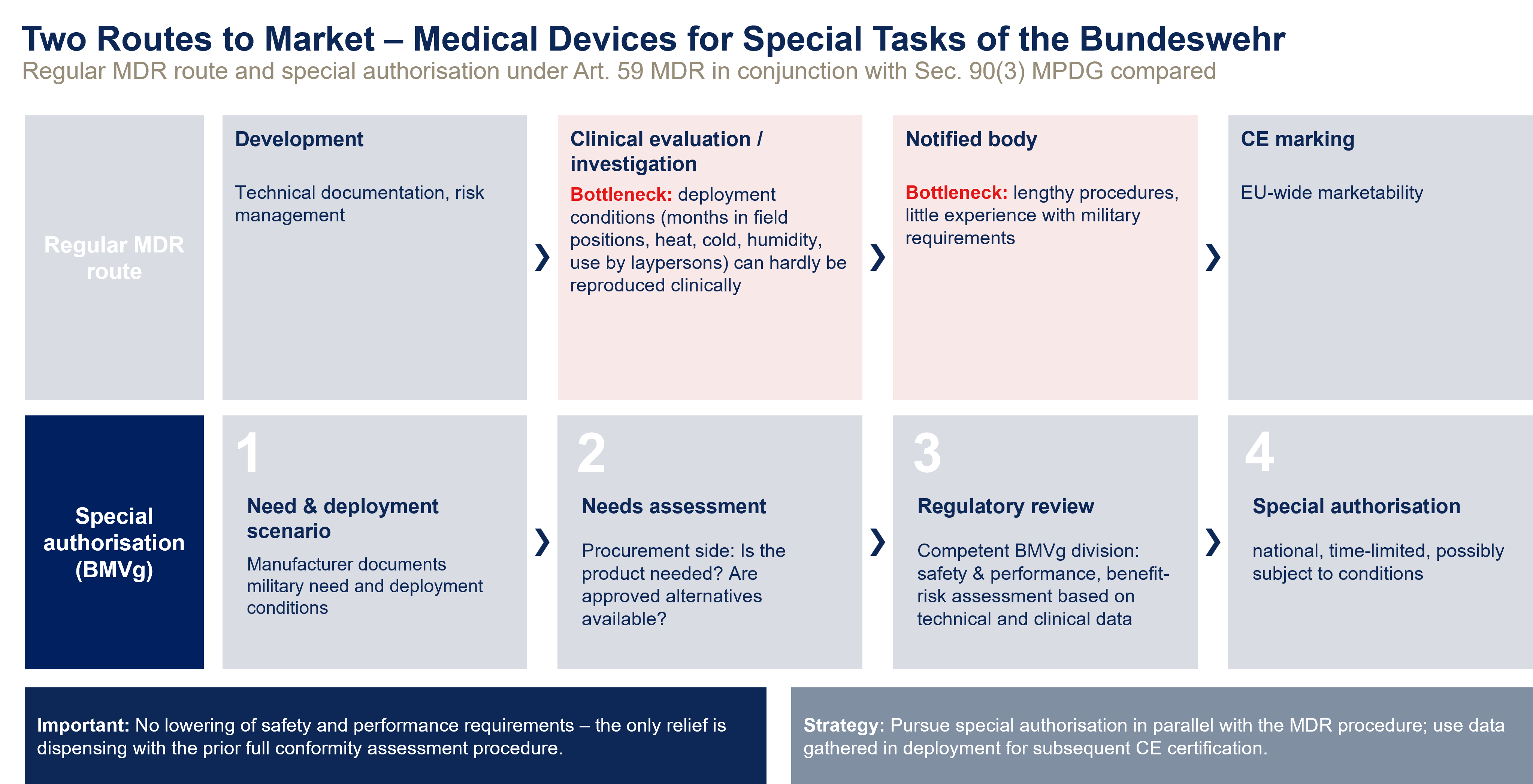
Chart: Regular MDR route and special authorisation under Art. 59 MDR in conjunction with Sec. 90(3) MPDG
In practice, the procedure involves two stages: First, the procurement authorities assess whether the product is actually needed by the armed forces and whether suitable CE-marked alternatives [wjo1.1]are available. Once a need has been established, the competent division within the BMVg examines the regulatory requirements for the special authorisation based on the documents submitted by the manufacturer.
The application can formally be submitted via the German Medical Devices Information and Database System (“DMIDS”) by selecting the BMVg as the competent authority. However, this electronic route does not yet reflect how applications are handled in practice, as the documents are not automatically forwarded to the responsible division. In addition, responsibilities within the ministry frequently change as a result of reorganisations and staff[wjo2.1] rotations. In our experience, direct contact with the relevant offices is both welcome and essential.
C. CLINICAL DATA UNDER DEPLOYMENT CONDITIONS: WHERE SPECIAL AUTHORISATION COMES IN
Special authorisation is particularly valuable for products used under extreme conditions by personnel without specialist medical training. Clinical investigations require controlled conditions that cannot adequately replicate actual deployment conditions – prolonged storage in the field, heat, freezing temperatures, wet conditions, vibration, use under stress and without medical supervision. The full clinical evidence required under the regular MDR procedure can therefore often only be obtained with disproportionate effort, if at all.
Article 59 MDR does not require that this evidence be provided in full as part of a completed conformity assessment procedure. What matters is that the BMVg can carry out a robust benefit-risk assessment based on the technical and clinical data submitted. This allows for a deployment-specific evidence strategy that may combine the following elements:
- technical tests to assess robustness and functionality under simulated environmental conditions (e.g. temperature, humidity and storage stability tests),
- usability studies involving users without medical training to demonstrate that soldiers can use the devices safely,
- existing clinical data, literature and experience with comparable products, and
- findings from trials conducted by the Bundeswehr itself.
By contrast, the BMVg is unlikely to rely on foreign approvals alone. However, this assessment could change in an acute crisis or, at the latest, in the event of a prolonged deployment of the armed forces in a war zone or collective defence under Article 5 of the North Atlantic Treaty. A practical example illustrates the extent of the need: warm whole-blood donation is permissible in combat, yet the medical devices required for this purpose, such as transfusion bags, have not yet been approved for such use.
D. NO COMPROMISE ON SAFETY AND PERFORMANCE
Special authorisations are not a regulatory carte blanche. The general safety and performance requirements continue to apply under Article 59 MDR. The exemption does not eliminate the need to demonstrate safety and performance; rather, it allows a device to be placed on the market or put into service without first completing the full MDR conformity assessment procedure. Experience to date shows that incomplete documentation is the most common reason applications fail.
E. UNTAPPED POTENTIAL FOR GREATER FLEXIBILITY
To our knowledge, the BMVg has not yet granted a special authorisation for a medical device under section 90(3) MPDG, although the explanatory memorandum to the Act refers to a comparable case in the past (Bundestag printed paper 19/15620, p. 158). In the cases considered to date, the requirements were deemed not to have been met. Yet this presents an opportunity: the flexibility afforded by Article 59 MDR – particularly the possibility of dispensing with a conformity assessment procedure involving a notified body – appears to offer greater scope than the administrative practice to date. This is particularly relevant for innovative products developed specifically for military deployment conditions, required only in small quantities or intended primarily for military use.
F. FURTHER EXEMPTIONS FOR THE MILITARY SECTOR
In addition to special authorisations, other exemptions are available for the military sector. Under certain conditions, section 91 MPDG permits exemptions from specific provisions of the MPDG and the statutory ordinances issued under it, as well as exemptions from the requirement to observe expiry dates for products intended for special tasks of the Bundeswehr – a particularly useful option for the long-term stockpiling of medical supplies. Section 18(3) MPBetreibV also provides for limited exemptions from operator requirements, for example with regard to maintenance or documentation obligations. In each case, safety and health protection must remain assured, and European requirements must not preclude such exemptions.
G. RECOMMENDATIONS FOR MANUFACTURERS
Manufacturers developing products for military deployment are advised to
- assess and document military needs and deployment conditions (storage, climate, user group) at an early stage,
- engage directly with the Bundeswehr procurement offices and the relevant offices within the BMVg early on, rather than relying solely on the electronic application route,
- develop an evidence strategy tailored to deployment conditions, combining technical tests, usability evidence and existing clinical data,
- incorporate special authorisation as a separate route into their development and market access strategy and, where appropriate, pursue it alongside the MDR conformity assessment procedure, and
- ensure that data obtained in connection with a special authorisation can also be used for subsequent MDR conformity assessment.
H. CONCLUSION
Special authorisation under Article 59 MDR in conjunction with section 90(3) MPDG is not yet an established “fast track” procedure for medical devices in the defence sector. However, it offers flexibility that has so far remained largely untapped, primarily because the option is not widely known. For products used under extreme conditions by personnel without specialist medical training, and for which clinical investigations are feasible only to a limited extent, special authorisation can offer an attractive alternative or complement to the regular MDR conformity assessment procedure.
With administrative practice still evolving, companies that align their regulatory strategy and product development with military needs at an early stage stand to benefit. The scope for regulatory flexibility is greater than current practice might suggest.
 Forward