

Directive (EU) 2024/1785 fundamentally overhauls the Industrial Emissions Directive (IED), combining stricter environmental performance limits with leaner, digital processes. Member States were required to transpose the amended IED into national law by 1 July 2026. Germany will do so by means of an omnibus act containing amendments to the Federal Emissions Control Act (Bundes-Immissionsschutzgesetz, “BImSchG”), the Closed Cycle and Waste Management Act (Kreislaufwirtschaftsgesetz, “KrWG”), and the Federal Mining Act (Bundesberggesetz, “BBergG”) and an omnibus ordinance that expands the 4th Ordinance on the Implementation of the Federal Emissions Control Act (Bundes-Immissionsschutzverordnung, “BImSchV”) and introduces a new 45th BImSchV on mandatory environmental management systems. The Bundestag passed the omnibus act in the version proposed by the Environment Committee on 9 July 2026. The legislative process has resulted in substantive changes to the original ministerial draft. The omnibus act still requires approval of the Bundesrat, which is expected in September after the summer recess. Approval is also still pending for the accompanying omnibus ordinance, the draft of which was adopted by the German Federal Cabinet on 21 January 2026. Lawmakers seek to more effectively limit emissions from industrial installations and accelerate planning and permit procedures. This article outlines the implementing legislation now passed and highlights the most important new obligations and challenges for companies.
Policy background and objectives
The Industrial Emissions Directive (Directive 2010/75/EU) is the most important European regulatory framework for the approval and operation of environmentally relevant industrial installations. By amending the Directive, the EU aims to improve the environmental performance of industrial installations – specifically by curbing CO₂ emissions and increasing resource efficiency – while supporting the extensive shift towards a climate-neutral economy as part of the European Green Deal.
The revised Directive establishes the obligation to implement an environmental management system (EMS) as a core regulatory tool, placing new obligations on operators of IED installations and increasing their accountability for environmental protection and resource conservation. The amended IED also introduces a comprehensive measurement and data collection system that will enable continuous monitoring by authorities and reduce subsequent requests for information. The digitalisation of communication with authorities, introduced under section 64a BImSchG (new version), serves to further accelerate (permit) procedures – another key objective of the amendment.
The Directive also establishes an Innovation Centre for Industrial Transformation and Emissions (INCITE), which is to collect and analyse information on technologies for decarbonisation, resource efficiency and the circular economy. Its findings will help update the BAT reference documents. Monitoring INCITE’s publications will allow companies to identify future technological requirements well in advance.
Implementation and timeline
- EU level: Amending Directive (EU) 2024/1785 entered into force on 4 August 2024. The transposition deadline for Member States expired on 1 July 2026.
- National level (Germany): The regulatory changes required by the Directive will be implemented via an omnibus act that amends various individual statutes (BImSchG, KrWG, etc.). The omnibus act was passed by the Bundestag on 9 July 2026 with the support of the coalition parliamentary groups. The act is accompanied by an omnibus ordinance that amends various statutory regulations (in particular the 4th BImSchV) and, amongst other things, introduces a new 45th BImSchV.
- Transition periods: Pursuant to section 3(1) draft 45th BImSchV, operators must implement an environmental management system by 30 June 2030 or, for installations commissioned after that date, by the date of commissioning. Under section 6(1) draft 45th BImSchV, operators of existing installations must submit proof of conformity for the required environmental management system by 1 July 2030, with an initial internal audit by the operator being sufficient. The option of conducting an initial internal audit is also available for newly commissioned installations and installations brought within the IED scope at a later date. Proof of conformity must be provided upon commissioning for any new installations put into service on or after 1 July 2030. Section 67 BImSchG (new version) sets out transitional provisions for installations that fall under the scope of the IED for the first time following its expansion. For example, cold rolling mills and textile and fibre finishing plants commissioned before 1 July 2026 must likewise comply by 1 July 2030. For certain pyrolysis plants, the compliance requirements will only apply from the date on which an implementing decision on certain pyrolysis BAT conclusions is published in the Official Journal of the European Union, but no later than 1 September 2034. Installations that were first granted a licence before the date of publication must comply with the requirements within four years of publication, but no later than by 1 September 2034. The same applies to hammer or drop-forging installations with an impact energy of more than 50 kJ, forging installations equipped with forging presses exeeding a capacity of 30 MN per press, and battery manufacturing installations with an annual production capacity of at least 15,000 t of battery cells. Following the initial audit, an external audit is then required every three years. The specific deadlines may still change depending on the final wording of the omnibus ordinance.
Key changes
The changes only apply to industrial activities specified in the IED (IED installations). The rules still primarily apply to large-scale, environmentally relevant industrial installations, such as those for generating electricity or manufacturing chemical products.
Environmental management systems (EMSs)
IED installation operators are obliged to establish an environmental management system in line with Germany’s DIN EN ISO 14001 standard or the EU’s eco-management and audit scheme (EMAS). Livestock-rearing installations are exempted from this requirement and will be covered by a separate regulation. The requirements derive from sections 3 and 6 of the draft 45th BImSchV. The operator’s EMS must realise environmental policy objectives for the improvement of environmental performance, for example by taking action to prevent waste generation, optimise energy and water use, and increase the use of renewable energies. The action taken needs to be documented. Using an EMS allows public authorities to access structured documentation, thus accelerating official reviews and measures. Consistent with the objectives of the EU’s Environmental Omnibus package, the draft 45th BImSchV provides for a significantly simplified EMS and transitional arrangements. The draft originally required a full chemicals inventory and risk assessment of all hazardous substances present in or emitted from each installation. However, implementation of the obligation to explicitly include a chemicals management module in the EMS (inventory, risk assessment and substitution check for hazardous substances) has been deferred until further notice in view of the planned EU Environmental Omnibus package.
Transformation plans
The IED obliges operators of industrial installations to include a transformation plan in their EMS, describing what action they plan to take between 2030 and 2050 to help achieve a climate-neutral and circular economy.
Germany is holding back on implementing this obligation, however, because the EU’s Environmental Omnibus package envisages changes to the requirements. The draft 45th BImSchV provides for later regulation once the EU legal provisions have been updated.
Operators can obtain extensions to BAT emission limit deadlines by showing that their installations are in the process of deep industrial transformation. To do this, they will need to deliver a binding commitment, a timeline with milestones, and annual progress reports.
Audits
IED installation operators must audit their EMS for conformity with the provisions in section 2 draft 45th BImSchV. For existing installations, section 6(1) draft 45th BImSchV requires the first audit to be performed by 1 July 2030 and its results then sent to the competent authority. New installations must be able to produce proof of conformity at the time of commissioning (section 6(1) draft 45th BImSchV). Operators can opt to conduct their initial EMS audit internally. Confirmation of this audit by the operator suffices as proof that it has taken place. Following the first audit, operators must arrange for their EMS and implementation of its measures to be externally audited every three years as a minimum. After that, only valid certification under DIN EN ISO 14001 or an EMAS registration certificate count as proof of conformity.
Measurements and data
Under section 5 draft 45th BImSchV, IED installation operators must carry out detailed measurements and collect extensive data with regard to their environmental performance. Consumption and re-use of energy, water, raw materials and other resources, for example, need to be documented such that the operator and the competent authority can assess from the EMS whether the environmental policy objectives have been met.
Environmental performance limits
Under section 8 draft 45th BImSchV, companies will have to comply with binding environmental performance limits. These limits concern the consumption of material resources (especially raw materials) and water and are derived from the so-called BAT conclusions. BAT stands for “best available techniques” and refers to the most effective measures for reducing emissions, taking into account economic feasibility and the current state of the art. BAT conclusions are adopted by the European Commission in the form of implementing decisions. The BAT concept was already a component of the Industrial Emissions Directive 2010/75/EU.
Compliance with the limit values will be monitored by the authorities in accordance with section 9 draft 45th BImSchV. Operators must disclose their environmental performance data on request.
The implementation period for BAT limit values is generally four years following publication of the BAT conclusions (section 52a(1) BImSchG (new version)). That period can be extended to up to eight years for existing installations if supported by robust transformation plans (section 52a(2) BImSchG (new version)).
New regulation of installations requiring permits under the BImSchG
The list of industrial installations requiring permits under the 4th BImSchV has been revised to align more closely with Annex I to the IED. The scope will be expanded to include gigafactories for battery cell production, pyrolysis plants, certain smitheries with forging presses, and textile plants. This alignment reduces definition issues and procedural loops during the permitting procedure.
Strengthened public rights
The Directive strengthens public rights in several respects. In future, authorities must publish online the information available to them on whether an industrial installation complies with applicable limits (section 31(5) BImSchG (new version)). The same applies to operators of IED installations regarding key information from their environmental management system and proof of conformity (section 4 draft 45th BImSchV). However, participation rights in approval decisions, in particular for granting, updating and reviewing permits following the publication of new BAT conclusions, are restricted to the affected public (section 10(3), sentence 8 BImSchG (new version)). Furthermore, pursuant to section 10(6) BImSchG (new version), a consultation meeting will now be held only at the request of the project developer. Member States must guarantee effective access to justice. For businesses, all this means greater public scrutiny, although limiting participation to the affected public is also likely to speed up procedures.
Reporting obligations
Under section 7 draft 45th BImSchV, operators of IED installations must report annually to the competent authority on their progress towards achieving the environmental policy objectives set in the EMS. Reporting is to be performed electronically and can also be done by providing the location on the internet where the relevant information from the EMS is published (section 4 draft 45th BImSchV).
Penalties and liability risks
The implementation package sets out various penalties for the event that operators fail to comply with their new obligations:
- Breaches of the publication, audit and reporting obligations will in future constitute administrative offences within the meaning of section 62 BImSchG, see section 11 draft 45th BImSchV. Fines of up to EUR 50,000 may be imposed.
- For serious administrative offences – including breaches of EMS obligations – the reform introduces turnover-based fines of up to 3% of EU turnover for legal entities with total turnover of more than EUR 1.67 million.
- A new basis for civil law damages claims is introduced in section 65 BImSchG (new version). If the operator of an IED system breaches the central operator obligations in section 5(1), nos. 1 and 2, or sections 5(3) to 5(5) BImSchG and the health of another person is injured as a result, the operator becomes liable for damages. Under the Directive, damages claims procedures must be structured in such a way that they do not make it impossible or excessively difficult to assert claims. Consistent with Article 79a IED, the fault element is dogmatically linked to the breach of conduct-related duties of care. A provision imposing liability on public authorities for breaches of air-quality-plan requirements (former section 65(2) draft BImSchG) was dropped during the legislative process as it would have gone beyond the strict transposition of EU law.
- Regulatory oversight will include adherence to the future binding environmental performance ranges and limits (section 52a(7) BImSchG (new version)).Operators who do not comply with reporting and disclosure obligations concerning their environmental performance (part 2 and section 9 draft 45th BImSchV) will face fines.
- EU law background: The aforementioned penalty provisions transpose Article 79(1) and (2) of the new Industrial Emissions Directive, under which Member States must adopt penalties that are effective, proportionate and dissuasive and, in the case of serious breaches by legal entities, impose turnover-based fines.
- The draft also clarifies that, in future, security deposits for waste disposal facilities must be insolvency-proof and directly accessible to the competent authority (section 12(1), sentence 2 BImSchG (new version).
Outcome: Compared to current law, the risk of significant turnover-based penalties will increase. The new regime will be considerably stricter, particularly for larger companies.
Recommended action
- EMS roadmap for 2030: : Design an environmental management system (EMS) in accordance with DIN EN ISO 14001/EMAS, implement a data and measurement concept, prepare internal auditing and assign responsibilities.
- Environmental performance analysis: Identify shortcomings in environmental performance (consumption of material resources and water above BAT limits); track BAT monitoring and updates to environmental performance limits.
- Establish transformation plans to ensure that extensions of up to eight years can be sought for existing installations requiring high investment and if there is deep industrial transformation with respect to their adherence to environmental performance limits.
- Check the BImSchG list of installations: Check whether your industrial activity requires a permit under the amended IED (e.g. pyrolysis plants, smitheries, battery plants).
- Documentation, reporting and publication: Implement recurring, annual processes for publication obligations and disclosure/reporting obligations.
- Given the pending EU omnibus relief measures, companies can defer their establishment of chemicals management components in their EMSs for now, while monitoring legislative developments.
- Further mitigation of liability risks is generally advisable.
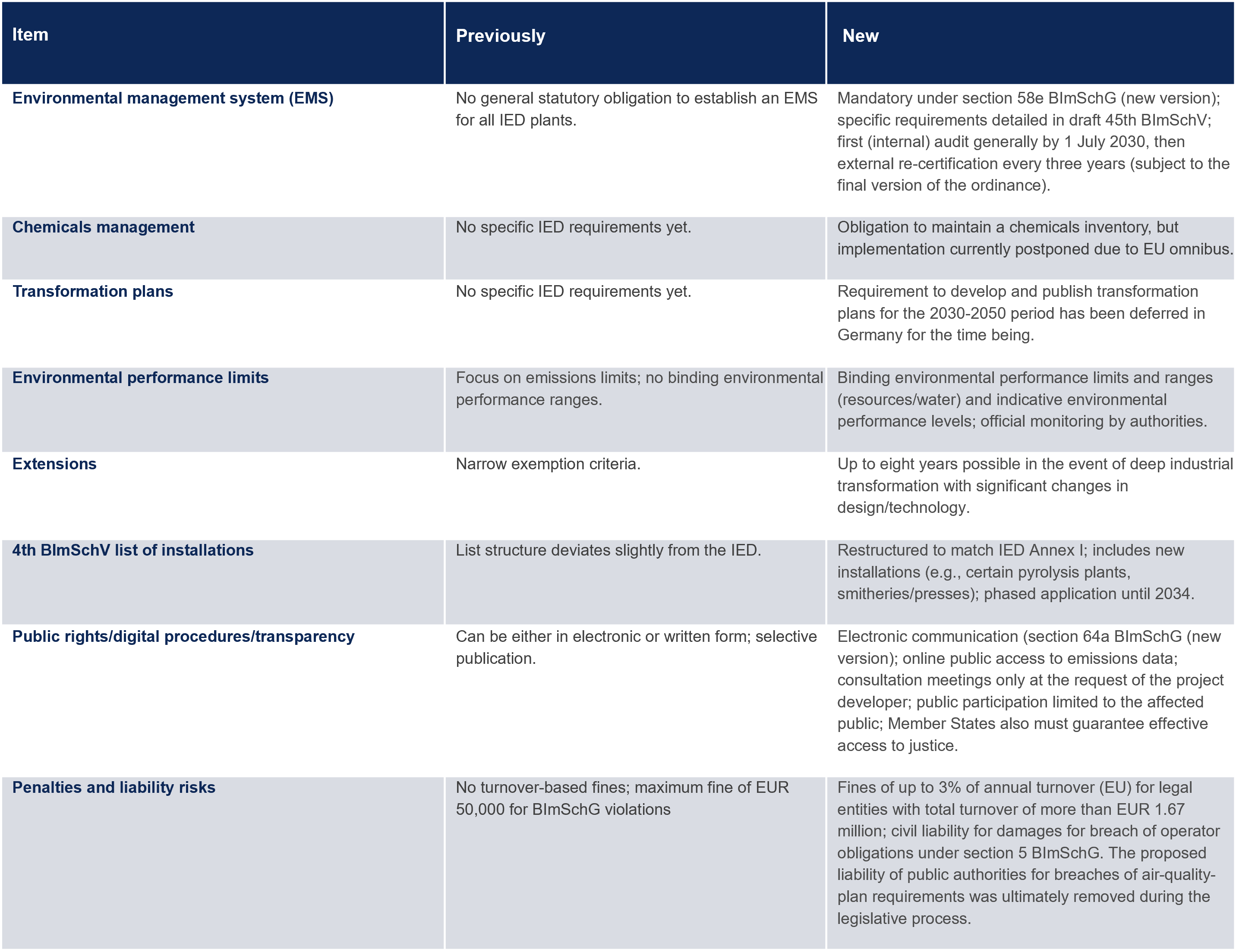
Overview – Before and After Comparison
Summary and outlook
National transposition of the IED through the omnibus act and the draft omnibus ordinance mark a fundamental update of German industrial emissions law. Key elements include the expansion of installations in scope, the mandatory introduction of environmental management systems (EMSs) with clear reporting, measurement and documentation obligations, and the setting of stricter, BAT-based limits for the environmental performance of IED installations.
Companies should use 2026 to establish an EMS, identify environmental performance gaps and plan transformation pathways. Transformation plans are especially advisable in view of the potential to use transition periods in justified cases. The omnibus act, like the draft omnibus ordinance already adopted by the Federal Government, still requires approval by the Bundesrat before it can enter into force.
 Forward