

On 17 July 2026 the new Packaging Law Implementation Act (Verpackungsrecht-Durchführungsgesetz, “VerpackDG”) was published in the Federal Law Gazette. The Act will align national packaging legislation with the requirements of the EU Packaging Regulation and replace the existing Packaging Act (Verpackungsgesetz, “VerpackG”). The key changes introduced by the EU Packaging Regulation – especially with respect to sustainability requirements, recyclability and labelling obligations – are discussed in detail in our article on the EU Packaging Regulation. This article focuses on the VerpackDG and explains the additional obligations that companies will need to meet.
What does the VerpackDG cover that the EU Packaging Regulation does not?
Regulation (EU) 2025/40 – the Packaging and Packaging Waste Regulation (“PPWR”) – has been in force since 11 February 2025 and includes a large number of new obligations relating to packaging, packaging materials and packaging waste (see our article on the PPWR of 1 December 2025). Many of these obligations will apply from 12 August 2026.
As a European regulation, the PPWR is directly applicable in Germany and does not require transposition into national law. The VerpackDG is therefore not intended to transpose the PPWR, but rather to facilitate implementation of the European requirements in Germany and set out responsibilities, procedures and supplementary provisions where the PPWR allows for national discretion or expressly assigns regulatory tasks to the Member States.
What hasn’t changed: Tried-and-tested structures from the VerpackG
Given that ensuring continuity is a key concern for the Federal Ministry for the Environment (Bundesumweltministerium), the packaging waste management structures established in Germany under the VerpackG have therefore been retained wherever possible and carried over into the new VerpackDG. This relates in particular to:
Dual systems for the collection and recovery of packaging waste:
The VerpackDG retains the concept of the “system” from the previous VerpackG. The term refers to private system operators that organise the nationwide collection and return of packaging requiring licensing from those systems (e.g. via the yellow waste bag or bin) on behalf of packaging producers. The systems therefore assume responsibility for the disposal and recovery of sales packaging, relieving producers of the obligation to carry out these tasks themselves. Although EU law does not obligate businesses to use such systems, the German government decided to make it compulsory to obtain licenses certain categories of packaging from one of the system operators (“licensing requirement”). This continues to apply under the new VerpackDG.
The old VerpackG laid down a licensing requirement for packaging waste that typically accumulates in private households or comparable establishments such as restaurants, hotels and canteens. This collection and disposal of packaging waste from households and comparable establishments exists alongside the established municipal waste management system, which is why the term “dual systems” is used in Germany.
The new VerpackDG retains the term “systems” (section 3(8)), but adapts it to the new EU terminology, defining them as “producer responsibility organisations” within the meaning of the PPWR.However, they continue to require authorisation from the relevant state authorities (section 20 VerpackDG).
Licensing requirement only for certain packaging:
The licensing requirement, which is specific to Germany, continues to apply. The PPWR contains an opening clause that allows Member States to make participation in a producer responsibility organisation mandatory (Article 46(1), sentence 2). Germany has made use of this option by maintaining the distinction between packaging that requires licensing and packaging that does not.
Packaging requiring licensing is packaging that typically ends up as waste in private households or comparable establishments such as restaurants and hotels. In contrast, packaging not requiring licensing is primarily packaging that accumulates in the B2B sector. As previously, producers of packaging requiring licensing must obtain licenses from a system for returning packaging waste before placing the packaging on the German market (section 7 VerpackDG). The key criterion continues to be the place where the packaging waste typically accumulates.
Central Agency Packaging Register:
The Central Agency Packaging Register (Stiftung Zentrale Stelle Verpackungsregister, “ZSVR”) will retain its previous responsibilities and be granted additional powers. It will remain responsible for registering producers in the LUCID packaging register (section 19 VerpackDG) and for monitoring licensing.
The ZSVR’s new duties will notably include granting authorisation to producers of packaging that does not require licensing (section 19 VerpackDG) and to other producer responsibility organisations (section 22 VerpackDG).
Declaration of completeness:
Major producers of packaging requiring licensing must continue to submit an annual declaration of completeness regarding the packaging quantities placed on the market in the previous year (section 10 VerpackDG). The thresholds for producers exempt from this obligation will remain unchanged (80 tonnes of glass, 50 tonnes of paper/cardboard, 30 tonnes of other materials).
Beverage packaging requirements
The existing German provisions on single-use deposits, reuse quotas and minimum recycled content for beverage packaging essentially will remain in place:
- Single-use deposit: The deposit requirement for single-use beverage packaging will continue to apply and remain EUR 0.25 per container. Retailers will still be required to take back returnable single-use beverage packaging and refund the deposit.
- Labelling obligations: The requirement to label items “SINGLE-USE” and “REUSABLE” in stores will continue to apply (section 47 VerpackDG).
- Reuse target: The long-term target for the share of beverages filled in reusable containers will remain at least 70% (section 44 VerpackDG).
- Collection thresholds: As before, at least 77% (90% from 2029) of single-use plastic beverage bottles made available in Germany for the first time must be separately collected for recycling.
- Minimum recycled content for single-use plastic beverage bottles: The existing national provisions will continue to apply (section 45 VerpackDG). Since 1 January 2025, PET bottles must include at least 25% recycled content and starting 1 January 2030, recycled material must make up at least 30% of all single-use plastic beverage bottles.
What’s new: The most important changes
New authorisation requirements
The most significant change brought about by the VerpackDG is the introduction of extensive authorisation requirements. Whereas, to date, only systems for the return and recovery of packaging waste have required formal authorisation (section 18 VerpackG), in future more operators will be subject to authorisation, in particular:
- Producers of packaging not requiring licensing: Anyone making available in Germany for the first time packaging that is typically used for commercial purposes (e.g. transport or industrial packaging in the B2B sector) must in future register with the ZSVR (section 19 VerpackDG). The requirements for obtaining authorisation include proof of a properly organised system for the return and recovery of packaging waste, evidence of sufficient financial and organisational resources to fulfil take-back obligations, and provision of an insolvency-proof financial guarantee.
- However, the authorisation requirement only applies if the producer chooses to organise the return and recovery measures itself. If the producer decides to transfer its extended producer responsibility to an authorised organisation (system) that fulfils these obligations collectively for a number of manufacturers, the requirement for the producer to obtain authorisation no longer applies (section 19(1), sentence 3 VerpackDG).
- Other producer responsibility organisations: According to the VerpackDG, organisations that collectively assume extended producer responsibility for producers of packaging not requiring licensing will also need to apply for authorisation from the ZSVR (e.g. commercial return systems) (section 22 VerpackDG).
Transitional periods for authorisation
The VerpackDG sets the following transitional periods for the new authorisation requirements (section 68 VerpackDG):
- Other producer responsibility organisations (B2B sector) must be authorised by 1 November 2027.
- Producers of packaging not requiring licensing are required to have authorisation for their own return system from 1 January 2028.
- Existing systems that have already been authorised (section 18 Packaging Act (Verpackungsgesetz, “VerpackG”)) must demonstrate compliance with the additional authorisation requirements in section 20 VerpackDG by 1 January 2027 (section 68(9) VerpackDG).
Increased recycling rates
The VerpackDG raises the recycling rates for certain packaging materials. The systems must meet the following minimum rates (in percent by mass) from 2028:
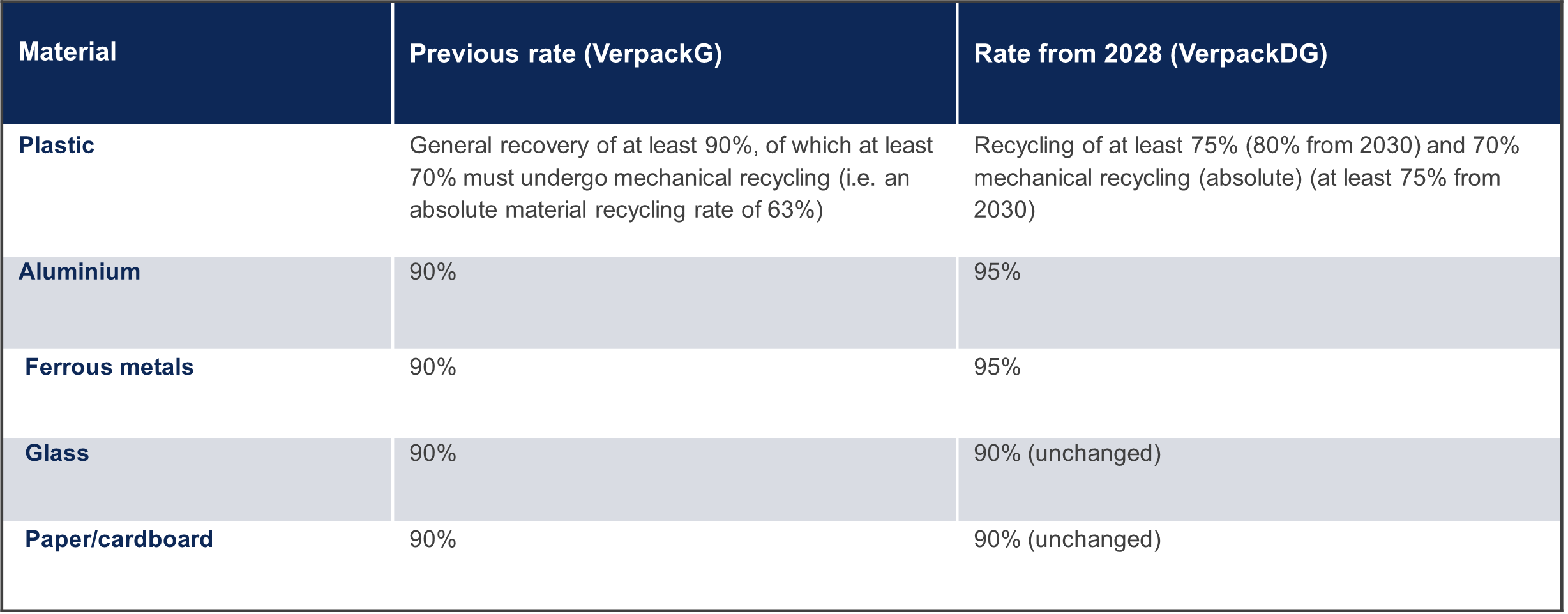
Plastic: Previously, the recovery rate for plastics also covered energy recovery via incineration (section 16(2), sentence 2 VerpackG in conjunction with section 6(1), no. 4 KrWG). Under the new VerpackDG, this will be replaced by a true recycling rate that no longer allows incineration to be counted. At least 70% – and from 2030 onwards, 75% – must be achieved through mechanical recycling. The aim is to reduce the share of plastics that ultimately end up in incineration plants.
Financing and contributions
The ZSVR will remain financed by contributions from the operators it oversees. What is new is that producers of packaging not requiring licensing and other producer responsibility organisations must now also share in its financing (section 51 VerpackDG). Contributions will be set at a level intended to cover the ZSVR’s anticipated costs in line with standard commercial principles.
Conformity assessment and market surveillance
The EU Packaging Regulation introduces – for the first time – the obligation for packaging manufacturers to carry out product law conformity assessment procedures. If packaging meets the requirements of the PPWR, manufacturers must issue a declaration of conformity. These requirements include restrictions on the use of certain substances in packaging, rules on recyclability and recycled content, the minimisation requirement, and mandatory labelling specifications (for more details, see our article on the EU Packaging Regulation). Packaging may only be placed on the market if it meets these requirements; if not, manufacturers must apply corrective measures or withdraw or recall the packaging.
The new VerpackDG also contains the following:
- The EU declaration of conformity may be issued in German or English; upon request by the authority, a translation must be provided (section 62 VerpackDG).
- In the event of non-compliance, the EU Commission and the other Member States must be informed by the Federal Institute for Occupational Safety and Health (“BAuA”).
- The competent market surveillance authorities are determined under the respective laws of the German federal states.
Administrative fines and sanctions
The VerpackDG includes extensive provisions on administrative fines (section 66 VerpackDG). Breaches of the obligations described above may result in fines of up to EUR 200,000. This applies in particular to:
- Placing packaging on the market without prior registration (up to EUR 100,000)
- Operating a system or organisation without the required authorisation (up to EUR 200,000)
- Non-compliance with the licensing requirement (up to EUR 200,000);
- Incomplete or late reporting of data (up to EUR 100,000).
The disgorgement of profits is also envisaged. The fine must generally exceed the economic benefit obtained from the offence. Where the legal maximum is not sufficient to eliminate the economic benefit, the fine may be significantly increased (section 17(4), sentence 2 Act on Regulatory Offences (Gesetz über Ordnungswidrigkeiten), OWiG).
Section 66(2) VerpackDG also sets out a wide range of administrative offences for non-compliance with the directly applicable obligations of the EU Packaging Regulation – such as sustainability requirements and labelling obligations. Under a transitional provision, these will not take effect until 12 February 2027, giving affected businesses a six-month grace period (section 68(15) VerpackDG).
Recommendations for companies
Based on the PPWR and the German implementing act, the following practical recommendations should be considered:
Short-term:
- Role assessment: Companies should determine in which role they could be affected – as a manufacturer, importer or distributor of packaging. Producers are subject to extended producer responsibility obligations. Some of the terms and definitions under the EU Packaging Regulation deviate from those found in the existing Packaging Act.
- Verify registration: Producers must ensure they are properly registered in the respective national packaging registers (in Germany, the LUCID packaging register).
- Verify licensing requirements: Companies should check whether they have packaging requiring licensing and whether it has been properly licensed from a system.
Medium-term:
- Verify authorisation requirement: Producers of packaging not requiring licensing must decide whether they wish to fulfil their obligations by taking back that packaging themselves (for which they must obtain authorisation) or by transferring responsibility to another producer responsibility organisation.
- Complete authorisation procedure: Other producer responsibility organisations must obtain authorisation by 31 October 2027, and existing systems that already have authorisation must demonstrate compliance with the additional authorisation requirements under section 20(2) VerpackDG by 1 January 2027.
Long-term:
- The requirements of the EU Packaging Regulation (e.g. minimum recycled content, prohibitions of certain packaging) will be phased in over time. Key priorities include bringing packaging in line with the new recyclability standards, ensuring that mandatory minimum recycled content targets for plastic packaging are met, and assessing whether any packaging formats fall under the prohibitions set out in Annex V EU Packaging Regulation.
Conclusion and outlook
The VerpackDG aims to maintain continuity in German packaging law, while aligning national rules with the European framework, where necessary. For companies, this means that familiar structures such as the dual systems, the ZSVR, the licensing requirement for packaging, and the deposit regime will remain in place. The key changes introduced by the VerpackDG primarily concern the expansion of authorisation requirements (notably for B2B packaging) and the increase of the recycling targets that apply to system operators.
The Bundestag passed the law on 11 June 2026, and it was published in the Federal Law Gazette on 17 July 2026. The Act will enter into force on 12 August 2026, the same day that the key provisions of the EU Packaging Regulation take effect.
Given the complexity of the new requirements, businesses should begin preparing early.
Our article “The new EU Packaging Regulation: Key requirements from August 2026” and our podcast product.compliance.bites (German) provide an in-depth summary of the extensive new obligations companies will face.
 Forward